March Market Commentary

Holding Steady Through Noise at Home and Abroad
It’s been a heavy start to the year.
Just as markets were processing tariffs and the acceleration of AI, geopolitical tensions escalated further with the U.S. entering conflict with Iran. Initial reactions were sharp, but markets stabilized as investors began to price in the possibility that this may not become a prolonged disruption.
Oil prices, however, have moved meaningfully higher. The administration has signaled a willingness to prioritize broader strategic goals over short-term energy costs, while also attempting to offset some of the economic impact through policy measures.
At home, the data is sending a quieter—but important—signal.
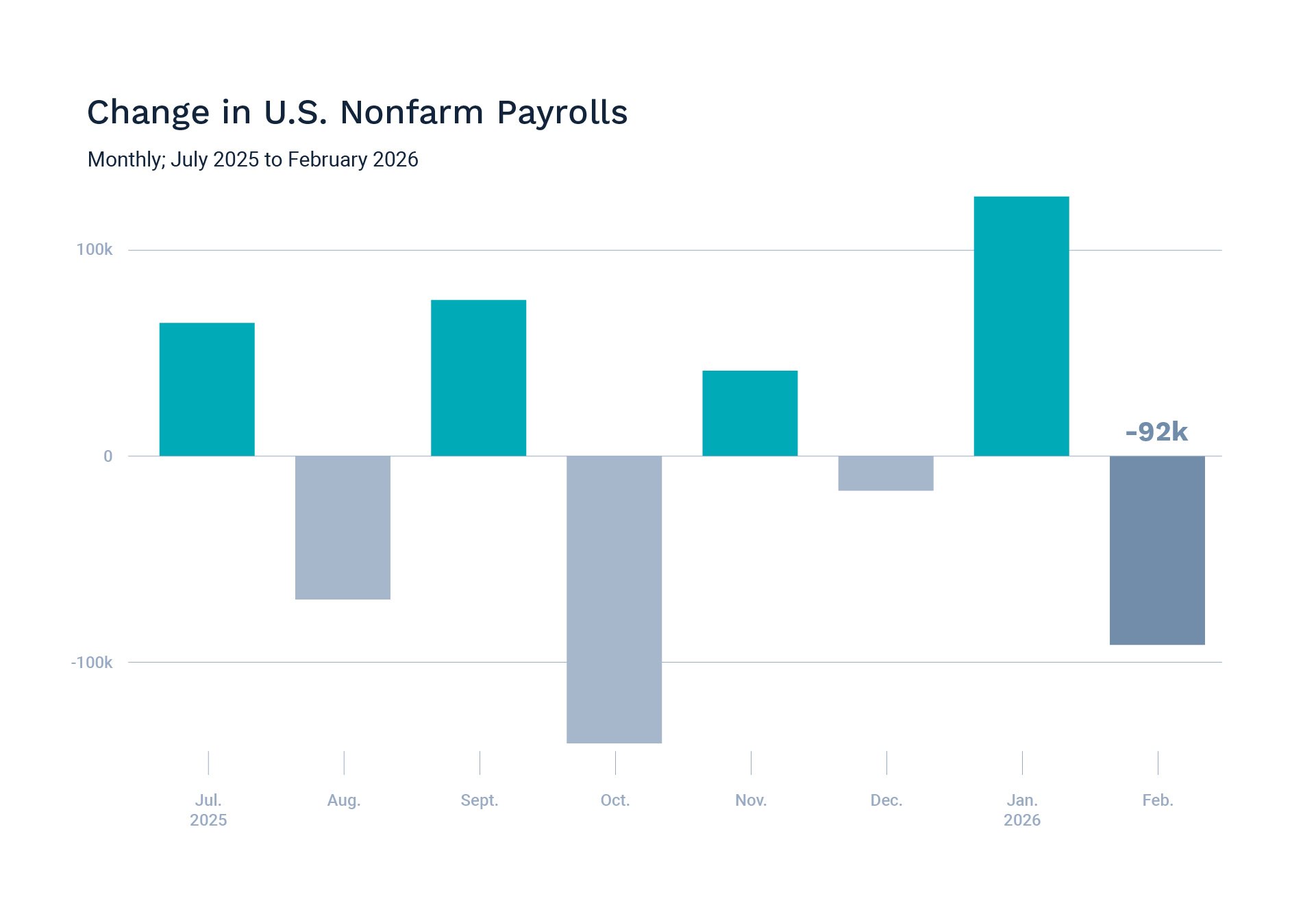
The labor market surprised to the downside, with a loss of 92,000 jobs and downward revisions to prior months. This suggests the economy is not absorbing the combined pressures of AI disruption, tariff uncertainty, and immigration policy shifts as smoothly as expected.
So where does that leave us?
A slowing growth environment, a softening labor market, and rising geopolitical risk—particularly around energy and inflation.
Let’s walk through the data.
What the Data Is Telling Us
Source: Bureau of Labor Statistics; Axios Visuals
Labor Market: Non-farm payrolls declined by 92,000 in February, versus expectations for a 50,000 gain. Unemployment ticked up to 4.4%.
Inflation: CPI held steady at 2.4% year-over-year.
Consumer Sentiment: The University of Michigan index dropped to 55.5, reflecting increased caution.
GDP: Fourth-quarter growth was revised down from 1.4% to 0.7%.
This isn’t a collapse—but it is a clear cooling.
At the same time, there are pockets of resilience. Corporate sentiment improved, with companies planning increased capital spending—largely tied to AI investment. What’s different this cycle is that investment may not translate into hiring the way it has historically.
Consumers are also adjusting. Spending remains stable, but savings rates have increased to 4.5%—a subtle but important shift toward caution.
The Bigger Question: What Comes Next?
The Federal Reserve is now in a delicate position.
There is growing pressure for rate cuts, and leadership changes may accelerate that direction. But with inflation still elevated—and the potential for higher energy costs—cutting too soon could introduce stagflation risks.
This is the balancing act ahead.
Markets in February
The S&P 500 declined 0.9%
Weakness was concentrated in software and insurance, where AI disruption is a growing concern
Utilities (+9.9%) and Energy (+8.8%) led the market
Consumer Discretionary (-5.4%) lagged
Interestingly, markets showed muted reaction to the Supreme Court ruling against broad tariffs—suggesting investors are still focused on larger macro forces.
Fixed Income Update
10-year Treasury yield: 4.21% (slightly down)
30-year Treasury yield: 4.64%
Bloomberg U.S. Aggregate Bond Index: +1.64%
Municipal Bonds: +1.25%
Bonds provided some stability this month, acting as they should in a more uncertain environment.
A Grounded Perspective
When headlines stack up like this, it’s easy to feel like something urgent needs to be done.
But this is often where investors get pulled off track.
Trying to interpret every data point or react to every narrative can create more noise than clarity. And over time, that’s what leads to inconsistent decisions.
This is where your plan matters most.
A well-built financial plan already assumes periods like this—slower growth, market volatility, uncertainty. These are not surprises. They are part of the cycle.
So instead of reacting, we come back to what we can control.
Staying invested with intention
Continuing disciplined contributions
Using tools like dollar-cost averaging to manage volatility
Aligning decisions with long-term goals, not short-term headlines
If anything, this environment reinforces the value of structure and consistency.
Especially as we move through tax season—this is a good time to revisit your plan for the year ahead. If you’re investing a tax refund or deploying cash, spreading it over time can help reduce the impact of market swings.
We’re here to help you think through these decisions—calmly, clearly, and in alignment with your bigger picture.
—————-
This work is powered by Advisor I/O under the Terms of Service and may be a derivative of the original.
The information contained herein is intended to be used for educational purposes only and is not exhaustive. Diversification and/or any strategy that may be discussed does not guarantee against investment losses but are intended to help manage risk and return. If applicable, historical discussions and/or opinions are not predictive of future events. The content is presented in good faith and has been drawn from sources believed to be reliable. The content is not intended to be legal, tax or financial advice. Please consult a legal, tax or financial professional for information specific to your individual situation.
This content not reviewed by FINRA
